
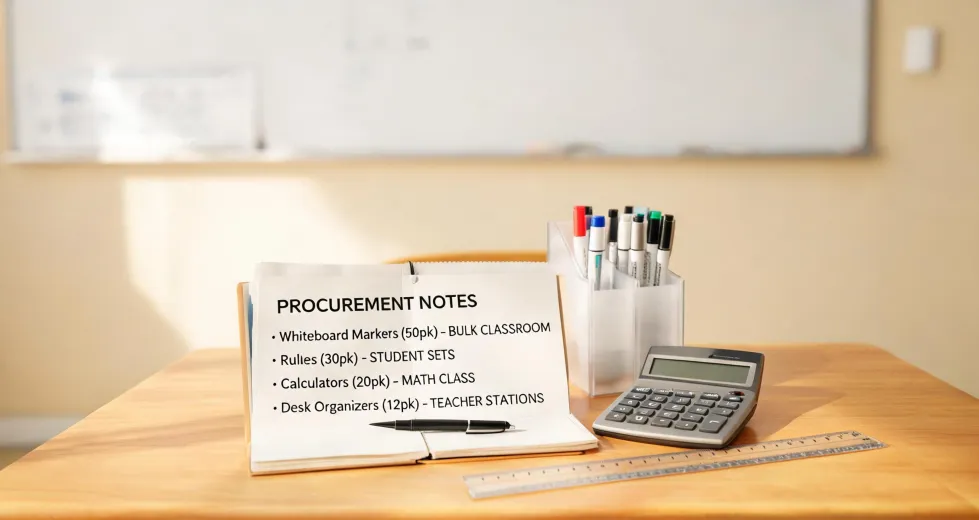
It started, as these things often do, with a frantic email from a second-grade teacher forwarded by my VP. The subject line was all caps: 'URGENT: STEM KITS FOR NEXT WEEK'. The actual message was calmer but the pressure was clear: our usual vendor was backordered, and a classroom science fair project was about to implode. That email was the first domino in a chain of events that completely changed how I approach procurement. I'm an office administrator for a mid-sized private school—about 400 students over three campuses. I manage all the non-IT supply ordering, which means roughly $120,000 annually spread across a frustrating patchwork of catalogues and online retailers.
When I took over purchasing in 2020, I inherited a system. And by "system," I mean a binder full of old invoices, a Rolodex of phone numbers for sales reps, and a deep-seated belief from previous admins that "this is just how it's done." The binder included notes on everything from algebra tiles to primary calculators. We had a great price for our whiteboards from one place, a good deal on measuring tapes from another, and a third vendor for all our pretend play school sets. Managing relationships with 8 different vendors for different needs was my norm. It felt thorough, but it was actually a logistical nightmare.
The problem with the backordered STEM kits was just the surface. The real issue was the time I was wasting. I'd spend two hours bouncing between websites, comparing shipping costs and minimum order quantities. I'd have three different invoices to process, reconcile, and submit to finance. Processing 60-80 orders annually sounds manageable, but each one had its own quirks. One vendor charged a $25 restocking fee if you didn't order in boxes of 12. Another required a minimum of $50 for free shipping, but the 'free shipping' excluded certain items (like the bulky classroom whiteboards). It was a comedic routine of hidden costs. I wish I had tracked the time more carefully from the start. What I can say anecdotally is that it was a full-day affair every two weeks.
The First Domino: A Supplier Audit
The crisis with the STEM kits forced my hand. I couldn't find a single vendor who could supply everything—Math manipulatives, STEM kits, pretend play sets, and measuring tools—with consistent pricing and delivery schedules. I assumed 'standard' meant the same thing to every vendor. Didn't verify. Turned out each had slightly different interpretations of what constituted a 'classroom bundle.' One vendor's '30-set' of algebra tiles was 30 individual sets, another considered a 'set' a group pack for 4 students. This cost us a $600 reorder for a grade level. A lesson learned the hard way.
So I decided to consolidate. The idea was simple: fewer vendors, less confusion. But I had to be smart about it. I couldn't just pick the cheapest one. I needed a partner who understood hands-on learning and could deliver classroom solutions, not just a product list. I started looking at suppliers that educators themselves recommended. I spent a week digging through online reviews and asking colleagues at other schools. It was during this investigation that I kept seeing the same name pop up: Learning Resources.
They weren't a cheap option—far from it. But they offered a comprehensive catalog that covered nearly everything in our binder. Tape measures, school rulers, primary calculators, and even a solid range of STEM classroom bundles. More importantly, they were a known quantity. They'd been a trusted name for 40+ years, which meant their products were built for classroom use, not just the living room floor. The idea of 'trusted by educators' resonated.
The Turnaround: A Smarter (Not Just Bigger) List
I pitched a consolidation plan to my VP. My core argument was simple, drawing from my own experience: "Time is a cost. I'm spending six hours a month chasing invoices. If I centralize, I can cut that to two hours, and the savings in my time will justify the slightly higher per-unit price on some items." To my surprise, she agreed. The biggest pushback came from the second-grade teacher, who loved the old system because she could order quirky items from a specific niche catalog. I get why people resist change—it disrupts their routine. But I argued that a more reliable, consistent supply chain benefited everyone in the long run.
Our first big order with Learning Resources was a consolidated classroom bundle for the fall semester. It included everything from STEM kits to math manipulatives to a new set of classroom whiteboards. The process was fairly straightforward. One purchase order. One invoice. One delivery. The delivery came in three pallets, but all from the same carrier. (Not ideal, but workable.) The inventory was perfectly itemized, which made checking it in a breeze compared to my usual 'two packages from different carriers on different days' scenario.
That's when the real magic happened. Because I had consolidated, I could spot trends. I saw that the 'pixel art learning resources' kits we ordered for a special project were a huge hit with the teachers. I saw that the 'ohms law calculator' request from the science department was a one-off, and I could just add it to the next regular order rather than making a special trip to a different website. The data started to tell a story. Switching to a single line of supply cut our order processing time from 5 days to just 2 days. The automated re-order system eliminated the manual phone calls we used to have. The best part? The accounting team reported a 30% reduction in invoice discrepancies. That unreliable patchwork of suppliers? I made them look bad to my VP when materials arrived late or with wrong specs. Now, I had a single point of accountability.
The Result: More Than Just a Budget Save
The immediate result was a budget surplus. We didn't necessarily pay less for individual items, but we drastically reduced the 'hidden costs' of managing multiple vendors—the time, the expedited shipping fees, the order errors. My estimate is we saved around $3,000 in hidden costs and about 20 hours of administrative labor per semester. To be fair, the initial commitment was a bit larger. We had to buy a 'classroom bundle' which required a higher upfront spend. But the long-term savings were undeniable.
But the bigger win was the internal satisfaction. The teachers started to trust the ordering process. They knew that if they requested a specific item from the approved list (a list I built using education resources learning opportunities from their curriculum guides), it would be there on time. It stopped being a point of friction. It became a service. The frantic emails from the VP dropped to zero. From my perspective, that alone was worth the switch.
Lessons for the Savvy Buyer
So, what did I learn? Three things, in order of importance:
- Ask teachers what they actually use. The best 'classroom solutions' come from the floor, not a catalog. I started doing quick 15-minute surveys. The answers were gold. They wanted hands-on learning design, not just flashy packaging.
- Negotiate the process, not just the price. The price per unit is only part of the story. Ask about return policies, order minimums, and how they handle backorders. The vendor who couldn't provide a proper invoice (a common problem with some smaller education toy shops) cost me $2,400 in rejected expenses once. That was a brutal lesson. Now I verify invoicing capability before placing any order.
- Don't underestimate the power of a good product. A cheap measuring tape that breaks in a week is more expensive than a durable one that lasts three years. This is especially true for items like 'tape measures' and 'primary calculators' that get heavy use. Learning Resources stuff lasts. That's why they have that 40+ year reputation.
I don't have hard data on industry-wide defect rates for classroom whiteboards vs. office-grade ones, but based on my 5 years of orders, my sense is that the cheaper alternatives crack or warp within the first year. That's a hidden cost no one talks about. So, when you're browsing for a STEM classroom bundle reviews or looking for a source for your algebra tiles classroom 30-set, pay attention to the real-world durability.
The final piece of advice? Think about the user. For a school, the 'user' is the teacher and the student, not just the admin. A 'pretend & play school set' that looks realistic and is made of sturdy plastic will get used for years. A flimsy one gets broken immediately, creating a complaint and another order. It’s a simple truth that often gets overlooked when you are just comparing prices on Math manipulatives. Efficiency isn't just about saving money on the spreadsheet. It's about saving time for everyone and delivering a better experience for the teachers. And that, honestly, is the best kind of efficiency.
Postscript: That second-grade teacher who emailed me? She's now my biggest fan. When the new STEM kits arrived, she built an entire unit around them. She even let me sit in on the kids using the pixel art learning resources. The look on their faces when they figured it out? That's the ROI that matters.