
-
The short answer: Don't trust the sticker price. Ask what's NOT included.
-
Why I'm qualified to warn you
- The three biggest mistakes I made (and how you can avoid them)
-
The transparency principle: why vendors who show all fees upfront win
-
What about the calculators and tools teachers often ask for?
-
Boundary conditions: when this advice doesn't apply
The short answer: Don't trust the sticker price. Ask what's NOT included.
After five years ordering classroom supplies for a district with 14 schools, I've personally made 22 significant purchasing errors — totaling roughly $3,200 in wasted budget. The biggest culprit? Assuming that "free" or "low-priced" options would actually cost less. They almost never do.
I now maintain our team's procurement checklist. The number one rule: always ask what's not included before you ask the price.
Why I'm qualified to warn you
I'm not a math teacher, so I can't speak to which calculator functions matter most for algebra. But from a procurement perspective, I've learned exactly how easy it is to overpay for what seems like a bargain.
In 2022, I found a website offering free resources for student learning — worksheets, lesson plans, even a circumference calculator tool. The catch? The "free" license only covered 30 students. Our district has 3,200. The upgrade cost? $1,200. Plus printing rights: another $400. Total waste: $1,600.
"People think free resources cost nothing upfront. Actually, the hidden costs of printing, copyright, and compatibility often exceed buying a quality classroom set."
The three biggest mistakes I made (and how you can avoid them)
1. Free resources? Check the fine print first
A teacher in our district requested a set of "printable circumference calculator" sheets from a popular site. I approved the download — it was free. Two weeks later, the teachers discovered the PDFs required a specific font license we didn't have. Recreating them cost $300 in staff time. Simple. Expensive.
Per FTC guidelines (ftc.gov), if something is claimed as "free," all conditions must be clearly disclosed upfront. But in education resource marketplaces, that's rarely the case. Lesson: always request a full terms document before downloading.
2. Texas Instruments calculators: the accessory trap
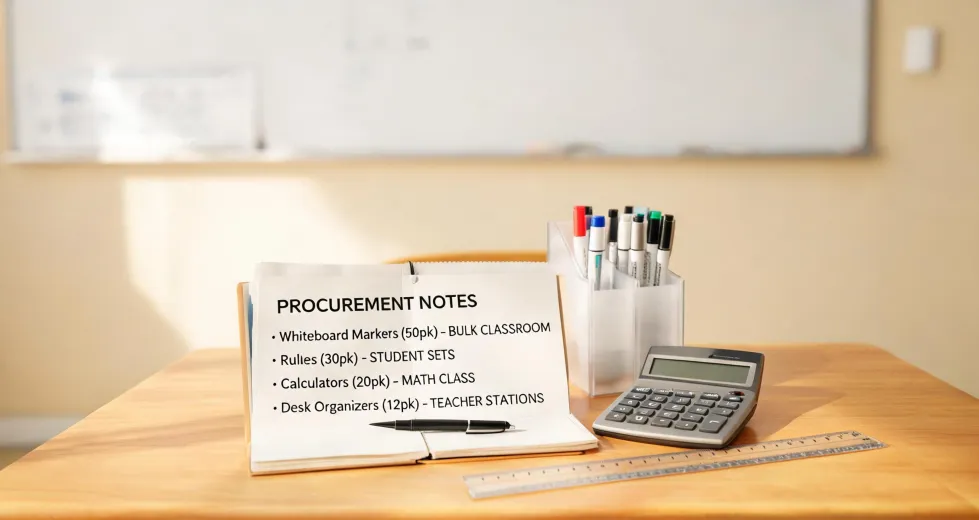
We ordered 60 Texas Instruments calculators for a high school math department. The price per unit looked great — until we realized the order didn't include batteries, USB cables, or the protective covers needed for district storage. Three things: batteries ($120), cables ($180), covers ($90). Total surprise: $390. The vendor (not TI directly) listed the calculator as "battery included" on the product page but buried the small print: "batteries for demo only, not for classroom use."
Looking back, I should have asked, "What's NOT in this box?" At the time, I assumed a classroom calculator would come ready to use. Now I read every specs line like a legal document.
3. School rulers: the inch vs. centimeter mistake
We ordered 200 Learning Resources school rulers — a brand I trust. The product listing showed both inches and centimeters. Perfect. But when the order arrived, the rulers only had inches on one side and millimeters on the other. Our math curriculum requires centimeter markings for measurement lessons. We had to return 150 rulers and reorder. Shipping fees: $80. Restocking: 15% of cost. Total waste: $210.
A lesson learned the hard way. Check the exact measurement scale before buying. Not all "dual" rulers are dual in the way you expect.
The transparency principle: why vendors who show all fees upfront win
After my $3,200 in mistakes, I started evaluating vendors differently. The ones who list every cost — shipping, handling, returns, replacements — even if their total is higher, usually end up cheaper in the long run. Why? Because you don't get surprised.
Here's what I now do:
- Ask for a total cost of ownership — not just unit price. This includes batteries, cables, warranties, shipping, and any "optional" accessories.
- Request a sample before any large order. A single school ruler can save you from a 200-ruler mistake.
- Verify claims with authoritative sources. For example, when a vendor says a calculator is "compatible with classroom bundles," I check the Texas Instruments official site for compatibility lists.
"The vendor who lists all fees upfront — even if the total looks higher — usually costs less in the end."
What about the calculators and tools teachers often ask for?
I'm often asked: "What is an odds calculator?" That's a math concept, not a physical tool. But when teachers ask for it, they usually just want a simple probability chart or a classroom activity. Instead of buying a specialized device, we now use free resources for student learning from our own district library — but only after vetting the licensing terms.
Similarly, circumference calculator requests usually mean a set of string and measuring tape. We buy Learning Resources measuring tools because they're designed for hands-on learning and come with teacher guides. The price is higher than a generic no-name brand, but the total cost (including training time and durability) is lower.
Boundary conditions: when this advice doesn't apply
This advice works best for large-batch orders where hidden costs can multiply. If you're ordering one Texas Instruments calculator for a single student, the accessory trap is minor. But for a 30-set classroom bundle? It adds up fast.
Also, I'm not a logistics expert, so I can't speak to shipping optimization — but from a procurement standpoint, always request tracking and delivery confirmation for orders over $500. We once had a $1,800 order go missing. No tracking meant no recovery.
Final note: The most expensive lesson I learned was to distrust the word "free" when it comes to classroom resources. The Learning Resources school ruler I mentioned? It was $3.50 each. The free ruler option from an unknown supplier? Two teachers complained about wrong scale, one broke immediately, and the rest were donated to arts and crafts. Not a savings. A waste.
So if you're a fellow procurement person or a teacher making a purchase request: ask what's not included first. It saved me $3,200. It might save your budget too.