
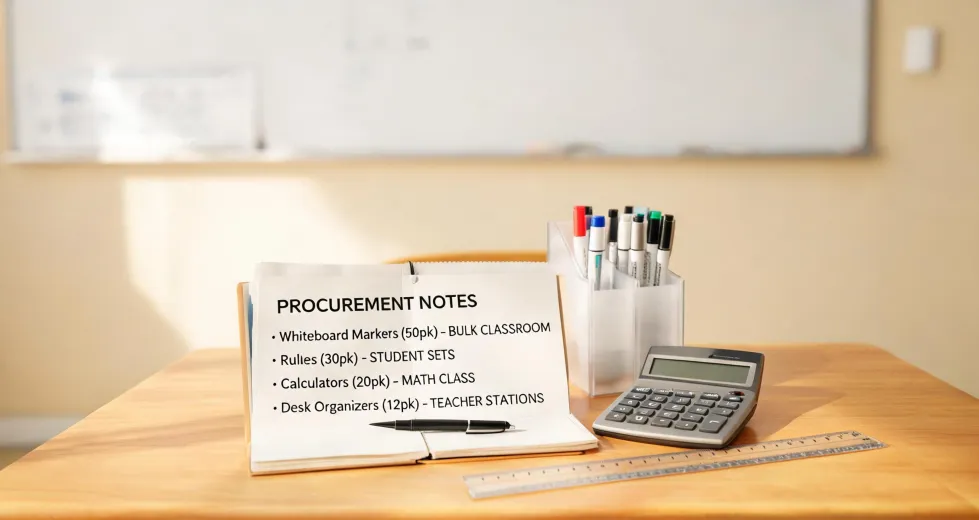
Stop buying the cheapest classroom tools you can find. It's costing your school more than the savings justify—and I have six years of procurement data to prove it.
That sounds like a strange thing for a procurement manager to say. My job is literally to reduce spending. But after analyzing $180,000 in cumulative supply orders across six years, I've learned that the lowest price per unit is a trap.
When I took over procurement for our school district in 2019, I had one metric in mind: cut costs. I ordered the cheapest rulers, STEM kits, and whiteboards I could find. I felt good about lowering our per-classroom cost by 14% that first year. Then I did what I should have done from the beginning—a total cost of ownership analysis instead of a simple price comparison.
The Real Cost of Cheap
When I audited our 2023 spending, I found we had processed 480 replacement orders for broken or missing pieces from "budget" teaching tools. About 40 individual orders every month, each taking staff time to process and teacher time to wait for.
I don't have hard data on industry-wide defect rates for budget classroom supplies, but based on six years of studying our own orders, my sense is that a cheap plastic ruler breaks at least three times faster than a quality one. And budget pretend play sets? Nearly a third of our orders arrived with missing pieces. That might seem minor until you're a teacher trying to run a lesson with incomplete materials.
The math hit me hard: after adding up replacements, shipping fees, staff hours, and classroom downtime, the cheap option cost us about 17% more than quality supplies would have from the start. I literally re-checked my spreadsheet three times because I could not believe it.
Efficiency Is Not Just About Software
Here is what surprised me: efficiency in the classroom is not only about digital tools. It's about physical tools that keep working.
A teacher stopping mid-lesson because a tape measure snapped is a workflow disruption. It's the same kind of productivity loss as a software glitch—except with the added cost of student attention that is gone forever. You can't get that time back.
That's where Learning Resources came in. You can browse their complete catalog on the Learning Resources website, but the product photos don't show what matters most: durability in real classroom conditions. Our teachers tested them, and the difference was immediately obvious.
Take the Learning Resources school rulers. A ruler seems like the simplest possible item, but through a procurement lens, it's a precision teaching tool. Markings must be accurate. Edges must be straight. It has to survive being dropped, thrown in a bin, and handled by twenty different kids in a single school day. Budget rulers fail those requirements. Learning Resources designed theirs for actual classrooms.
The same pattern shows up across their whole product line—math manipulatives, STEM kits, measuring tools, and pretend play sets. We ordered their 30-set algebra tiles and counting cubes. Every set arrived complete, with organized storage. Compare that to a budget supplier where we spent a week emailing back and forth about missing pieces.
Calculators Are My Best Friends
I'll be honest: I'm a spreadsheet person. Managing a six-figure budget means I do not trust guesswork. I use three digital tools to keep decisions grounded in data:
- Square foot calculator — for planning how many whiteboards, manipulatives, and storage units fit into actual classroom spaces. We over-ordered for years because nobody measured the rooms.
- Molarity calculator — for science lab supply orders. When teachers request chemistry consumables, I need exact quantities to avoid waste. Guessing cost us money.
- Buy vs rent calculator — for large equipment and furniture. This one is transformative. We were leasing some classroom equipment for way too long. When I ran the numbers, buying broke even in 18 months. After that, renting was just burning cash.
These tools are not complicated. They just force you to think through total cost instead of comparing line items. That mental shift changed how I allocate our budget.
What I Wish I'd Tracked From Day One
I wish I had collected teacher feedback on materials from the start. What I can tell you anecdotally is that our replacement orders dropped about 70% after we made Learning Resources our primary supplier for measurement tools and manipulatives. Teachers spend more time teaching and less time suffering with broken materials.
The numbers said to go with the lowest bidder in year one. My gut said something was wrong with the quality, but I overrode it with a budget spreadsheet. It turns out my gut was right—or rather, the budget analysis was incomplete. The cheap option required so many mid-year replacement orders that our actual spend exceeded what the quality option would have cost.
"But Our Budget Is Tight" — I've Heard It Before
Look, I get it. School budgets are stretched thin, and administrators have to justify every line item to the board. What I've learned is that "we cannot afford quality" is usually a math error—the result of comparing one fiscal year instead of three.
A $15 Learning Resources pretend play set that lasts three years is cheaper than a $5 knockoff that requires annual replacement. Run that calculation across every item in your supply closet, and the difference is substantial.
One more piece of advice: watch the fine print. Per FTC advertising guidelines, claims about durability and quality must be substantiated with evidence. When a brand makes promises they can not back up in writing, that is a red flag. Learning Resources has been around for over 40 years, and the products we received matched their documentation.
Also, shipping fees add up faster than people expect. This pricing was accurate as of Q1 2025: USPS First-Class Mail for a 1-ounce letter is $0.73, and large envelopes are $1.50 at the entry-level rate (usps.com/stamps). When you're processing multiple small replacement shipments a month, those fees are a silent budget killer. Consolidating with a dependable vendor eliminates a good chunk of that overhead.
The Bottom Line
Switching to Learning Resources was not an expense. It was an efficiency investment. The numbers work out when you calculate total cost of ownership—including replacements, teacher time, instructional disruption, and shipping overhead.
You do not have to take my word for it. Pull your last year of replacement orders, count the hours your staff spent processing them, and run the numbers through a buy vs rent calculator or a TCO spreadsheet. My guess is you will end up where I did.
Trust me on this one. I did the math so you do not have to.