
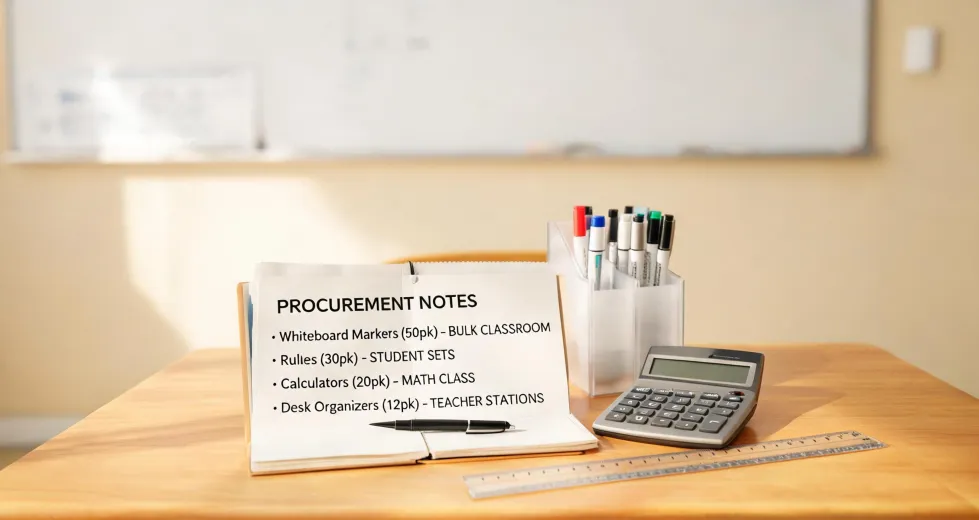
Every new learning resources school district order starts with a list: thirty rulers, twenty-four calculators, a dozen tape measures. Maybe a classroom whiteboard if there's budget left. Then the boxes arrive, someone opens one, and a fourth grader asks, “Which line is 0.43?”
That's when a good purchase starts to look like a gamble.
I'm the quality and brand compliance manager at Learning Resources. I review products before they ship—roughly 200 unique items a year. In Q1 2024, I rejected 11% of first production runs for issues like printing misalignment and material warping. I catch those problems before they reach classrooms. But many districts don't have someone doing that on their side.
The Cheap Ruler Trap
About two years ago (circa 2023), I watched a district save $250 on a 30-pack of rulers. The markings looked fine in the product photo. On arrival, the printed lines were slightly off, and after two weeks of use, the black ink started wearing away from the plastic. The replacement cost was $700, plus the lost math time. The “budget” rulers turned out to be the most expensive ones.
This is the penny-wise, pound-foolish problem I see constantly in school procurement. Based on online listings I checked in January 2025, a 30-pack of classroom rulers can run from about $12 to $40. That spread is small compared to the instruction time it buys or wastes.
The surprise wasn't the price difference between cheap and quality tools. It was how much time a clear ruler saves.
The Hidden Problem With Cheap Measuring Tools
The surface issue is obvious: faint markings, flimsy plastic. The deeper issue is less obvious. A ruler isn't just a measuring tool. It's a physical number line. When the marks are misaligned, faded, or cluttered with fractions, students aren't just reading wrong measurements—they're building a wrong mental model of our number system.
In our Q1 2024 audit, we found a batch of rulers where the printed markings were 0.8mm off from the spec. The vendor said it was “still readable.” We rejected the batch. Normal tolerance is tighter than that, and a child leaning over the desk shouldn't have to guess whether a line is in the right position.
The Decimal vs. Fraction Problem
Many classroom rulers still use fractions: 1/16, 1/8, 1/4. That's fine for certain lessons. But if your curriculum asks students to measure in decimals, a fraction ruler creates a hidden barrier. You're basically asking a child to convert 1/8 to 0.125 just to answer a question about tenths. That's not measurement; that's forced mental gymnastics.
That's why “how to read a ruler in inches decimals” is such a common search. People need to know where the tenths live. On a decimal ruler, each inch is divided into 10 lines. Count them: 0.1, 0.2, 0.3, all the way to 1.0. The halfway point is 0.5, not 1/2 written in tiny type.
A ruler marked only in fractions can still show decimal equivalents, but only if the teacher spends extra time converting. In a tight lesson, that's time lost. I'm not against fractions—I'm against tools that make the lesson harder than it needs to be.
I get the temptation to just use a digital calculator. Google has a calculator for nearly everything. Need to split dinner? A tip calculator Google search solves it in seconds. Need a clinical kidney estimate? A GFR calculator does the math instantly. But none of those digital tools teaches the underlying number sense. A clear classroom ruler still does.
The Real Cost of a Bad Measuring Tool
Let's move from the supply closet to the classroom. A 25-student class spends about 15 minutes on a measurement activity. If each student hesitates for ten seconds trying to decide whether the mark is 0.3 or 0.4, that's four minutes of net waste. Over a week, that's a ton of instruction time gone because of poor design.
The worse cost is confidence. When kids can't trust their tools, they assume they're bad at math. No, they're just working with a bad ruler.
This is also a procurement issue. A new learning resources school district initiative often gets evaluated by total cost. But total cost should include reorders, teacher prep time, and student frustration. I once saw a district spend $3,800 on a bundle, then another $1,200 replacing the measuring pieces before the second semester.
I've nearly made a similar mistake myself. So glad I double-checked the quantities before approving a large order. We were one click away from requesting ten times the number of calculators we needed.
What to Do Before You Buy
Honestly, the fix is simple in theory. Buy tools that match your curriculum, not just the catalog photo.
If your standards call for decimal notation, get a ruler marked in tenths. The Learning Resources official website lists grade level and standards alignment for each product, which saves a lot of guesswork. For example, CCSS 4.NF.C.6 asks students to use decimal notation for fractions with denominators of 10 and 100. A decimal ruler makes that visible.
Here's the short checklist I use when I evaluate a classroom measuring tool:
- Is the scale legible at desk distance? Small, gray, cramped numbers don't work.
- Does it match the decimals or fractions you teach? Don't buy a fraction-only ruler and expect students to read decimals fluently.
- Will the markings survive a school year? Ask about durability, not just price.
- Does the product come with teacher support or standards guidance? The Learning Resources official website is a good starting point.
And let's be honest about scope. Learning Resources doesn't build medical devices, and we don't try to replace your school's digital math platform. If you need a GFR calculator or a tip calculator Google search, that's not our lane. We make hands-on tools that help students understand the math inside those calculators.
How to Read a Ruler in Inches Decimals
If you are teaching decimal measurement, here's the straightforward version.
- Start with the whole inch. If the object ends after the 2-inch mark, write “2.”
- Count the tenths marks after the last whole inch. Each mark is 0.1 inch.
- The longer mark at five tenths is 0.5—halfway between two inch numbers.
- If the object falls between marks, estimate to the nearest tenth. 0.43 is just past the fourth mark (0.4) and before the fifth (0.5).
That's the entire trick. The math isn't hard once the ruler shows the pattern clearly.
When you plan new learning resources for a school district, treat rulers and measuring tapes like curriculum, not office supplies. A ruler is one of the first number lines a child ever uses. If it's clear, it teaches. If it's not, it becomes just another thing the teacher has to work around.