
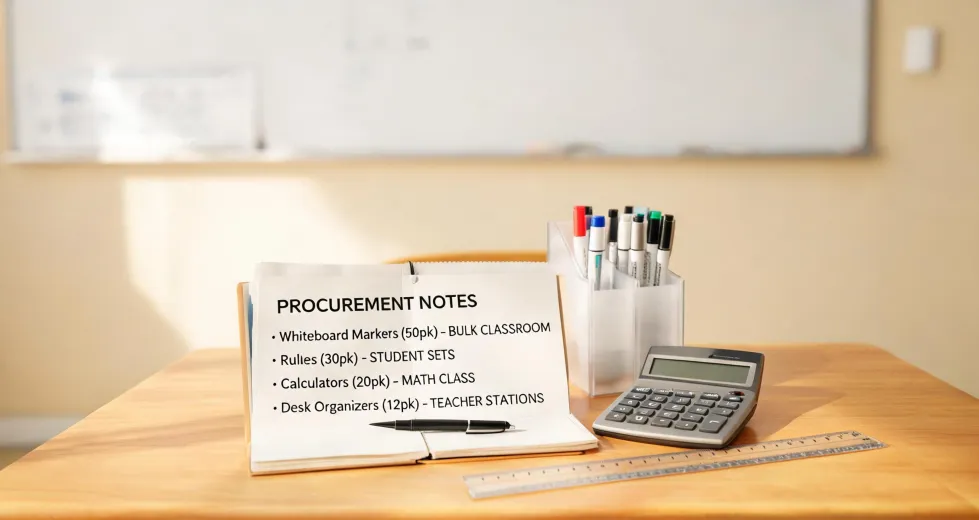
Last fall, our STEM coordinator asked for hands-on materials for four third-grade classrooms. The finance office asked me to do it for as little as possible. Those two requests led me to run a test I didn’t expect to write about: the Learning Resources STEM Classroom Bundle versus the do-it-yourself route, where I bought the pieces myself from discount school, art, and office suppliers.
A quick note first. If you found this by searching “sju office of learning resources,” you may be looking for a university student support office, not a classroom supplier. The term “learning resources” gets mixed up between the brand, university offices, free worksheet sites, and tutoring programs. This article is about physical classroom materials for schools.
Why I compared a ready-made bundle with a DIY kit
Background: I’m the office administrator at a private K-8 school with about 320 students. I handle purchasing for roughly 18 classrooms and report to both the head of school and the finance director. Every year I process 60–80 purchase orders across maybe 14 vendors. My job is the unglamorous middle: teachers tell me what they need, finance tells me what we can actually spend, and I make the two meet.
In October 2024, our STEM coordinator requested the Learning Resources STEM Classroom Bundle for four classrooms. Finance asked whether we could save money by making our own kits. So I did what any buyer would do: I priced both ways and tested them.
Here’s what I actually did:
- Two classrooms got the Learning Resources STEM Classroom Bundle at $189 per classroom (fall 2024 pricing).
- Two classrooms got a DIY kit I assembled from discount school, art, and office suppliers, at $158 per classroom.
I’m not a curriculum specialist, so I can’t tell you which set “teaches STEM better” or whether one approach raises test scores. What I can tell you, from a purchasing perspective, is what happened between the purchase order and the classroom shelf.
Sticker price: DIY won, no contest
At face value, the DIY route looked smarter. When I entered $158 and $189 into a percent increase calculator, the bundled kit came out 19.6% more expensive than my DIY kit. That’s a real difference. For a school watching every dollar, a 20% gap is not nothing.
And where to find cheap art supplies wasn’t a mystery. Back-to-school sales in July and August, overstock discount stores, and online warehouse retailers all had what I needed. I bought the calculators, rulers, tape measures, and storage bins from three different sources to get the lowest prices.
For about ten minutes, I felt good about that spreadsheet.
Setup time flipped the cost comparison
Then the boxes arrived.
The two Learning Resources bundles came in two boxes, on the same delivery, with one packing slip each. I counted the contents against the packing list, labeled the bins, and was done. Total setup time for both classrooms: maybe 40 minutes.
The DIY kits were a different story. I had ordered from three vendors to keep costs down, which meant five boxes spread across six days. One vendor backordered half the rulers. Two boxes arrived on a day no one was available to receive them. And when I opened everything, I still had to count, sort, bag, and label each item so the teachers wouldn’t spend their planning period doing it.
I spent roughly 3.5 hours preparing the two DIY kits. Maybe four hours—I’d have to check my notes. At a loaded rate of $35 an hour for my position, that’s about $140 of staff time.
Do the math again: two DIY kits cost $316 in materials, plus about $18 in shipping fees and $140 in setup time, for a total around $474. Two Learning Resources bundles cost $378, with no shipping charge and roughly $23 of my time for setup—about $401 total. The supposedly cheaper option ended up costing about $73 more.
I should add the obvious objection: my salary is fixed, so the school didn’t write an extra check for $140. But time isn’t free. It was time I didn’t spend on vendor quotes, budget tracking, or the other purchasing work that piled up that week.
The eight-week durability check
I didn’t stop at setup. Eight weeks later, before winter break, I did an inventory check of all four classrooms. This is the part that surprised me.
In the two DIY classrooms, we had 9 rulers missing or broken, and two of the budget calculators had stopped working. In the two Learning Resources classrooms, three rulers were missing and no calculators had failed. Missing pieces happen in any classroom—kids are kids. But the real difference showed up when I tried to replace them.
For the Learning Resources kits, I called customer service with the order number. The replacement parts were already listed on the bundle packing sheet, so ordering them took one phone call. The replacements arrived in a single shipment within three days.
For the DIY kits, I had to dig through receipts, hunt down a product that one vendor had already discontinued, and place a separate replacement order. I even had one vendor ship replacement rulers in a flat envelope that arrived bent. USPS defines a large envelope as up to 12 by 15 inches and three-quarters of an inch thick, so a 12-inch ruler technically fits—but “technically fits” isn’t the same as “arrives in good shape.”
That experience made me add a question to every purchase I make: Can I buy replacement parts for this item next year, or will I be starting over?
The part nobody sees: invoicing and product claims
If you’re an administrator, you know the real cost of a purchase isn’t always the price. It’s the paperwork.
In 2020, I found a great deal on classroom storage from a small vendor—about $75 less than our regular supplier. The catch: the vendor gave me a handwritten receipt and couldn’t provide a proper itemized invoice. Finance rejected the expense report, and I had to pull money from a different budget line to cover it. I still remember that mistake whenever a supplier says “we can work out the paperwork later.” No.
Now I ask for an invoice sample before I place the order. I also check whether a product’s claims match its documentation. Per FTC advertising guidance, marketing claims need to be truthful, not misleading, and supported by evidence. If a product promises better test scores or dramatic learning gains, I ask for the study. If the supplier can’t produce it, that’s a red flag—not because I doubt the product, but because I don’t want my school caught relying on an unsupported claim.
So which one should you buy?
The honest answer is: it depends on who is going to manage the kit after it arrives.
Buy the Learning Resources STEM Classroom Bundle when:
- You need identical materials across multiple classrooms.
- Teachers don’t have time to count, sort, and label supplies.
- You want one purchase order, one invoice, and one shipment.
- You need replacement parts to exist a year from now.
- Your staff time is already stretched thin.
Build your own kit when:
- You have a staff member whose job includes maintaining and replenishing materials.
- You can buy during back-to-school sales and have storage space to hold inventory.
- A teacher or instructional coach wants to customize the kit for a specific grade level or unit.
- You have the time to verify quality, count pieces, and handle multiple invoices.
For our school, the Learning Resources bundle won. Not because it’s a magic box, but because it saved teacher and admin time, simplified invoicing, and made replacements easy. The DIY route wasn’t a bad idea—it just wasn’t actually cheaper once I counted everything.
And if your finance director asks whether the materials will pay a dividend, don’t reach for a dividend calculator. Classroom supplies don’t generate cash returns. They generate time savings and repeat use—and that’s measured with an inventory checklist, not a stock portfolio.
Five minutes of verification before you order beats five days of correction after. That’s the real lesson I took from this test. The bundle just happened to be the version that made the point.