
-
The comparison framework I use
-
Product depth: brand catalog vs. general shelf
-
Total cost: sticker price is only the beginning
-
Ordering workflow and invoicing: where online ordering shines
-
Turnaround: online certainty vs. same-day local pickup
-
A side note on calculators and digital tools
-
When to use each: scenario recommendations
-
Final takeaway
I do the purchasing for a K-8 school. I report to the head of school and the finance director, which means I sit between teachers who need materials before tomorrow and a finance office that needs every invoice to be right. After about five years and more than 300 orders, I have learned that supplier decisions are less about brand names and more about process.
When a teacher asks for Learning Resources products, I usually have two options: the Learning Resources website (the brand's direct shop) and a local education supply store. The Learning Resources shop is not the only place to buy these products, but it is the channel I compare most often with local pickup. This is the comparison I wish I had found earlier.
The comparison framework I use
I do not compare only price. Price predicts the first week; process predicts the whole school year. My four criteria are: product depth, total cost, ordering workflow, and turnaround flexibility.
Why these four? Because in my first year, I made the classic rookie mistake of choosing a vendor based on a low list price while ignoring delivery timelines. The supplies arrived after teachers needed them. That was not the vendor's fault. It was my planning failure, and it taught me to compare more than price tags.
Product depth: brand catalog vs. general shelf
The Learning Resources website is easy to navigate when I need classroom-ready materials. I can find math manipulatives, STEM Classroom Bundles, the Primary Calculator, measuring tools, school rulers, tape measures, and a full Pretend and Play School Set. When I need an Algebra Tiles Classroom Set for a 30-student class, I can see whether the order includes enough tiles for groups to work in pairs.
A local education supply store is different. It carries a little of everything, but usually not in classroom quantities. The store might have one or two white dry erase boards on the floor, but it may not stock enough for a grade-level team. For a quick replacement item, that is fine. For setting up a STEM room, it creates extra phone calls and special orders.
The whiteboard example is the one I keep coming back to. After every white dry erase board order, I hear the same teacher question: how to clean a dry erase board so it does not ghost over time. On the Learning Resources website, the product documentation answers this clearly. The standard advice is to use a whiteboard-safe cleaner or a soft cloth with a mild cleaning solution and to avoid abrasive pads. At the local store, the person at the counter usually says to use dry erase cleaner, but cannot always tell me which cleaners are safe for the surface. That extra information matters when I am buying for twenty classrooms.
Winner for depth: the Learning Resources website, especially when the order is planned and curriculum-based.
Total cost: sticker price is only the beginning
I learned to look at total cost, not just the amount at the bottom of a quote. Total cost includes shipping, handling fees, invoice corrections, staff time spent tracking an order, and the cost of a delay.
When I compared a large order side by side, the Learning Resources website often came out ahead because I could bundle a STEM Classroom Bundle with other products and avoid separate delivery charges. The local store could order the same items, but splitting a 30-set across two shipments meant two invoices and more work for our finance team.
The surprising part? The local store was actually cheaper for small orders. A single replacement tape measure or an individual school ruler does not justify shipping. In those cases, the local store made sense and still does.
Winner: depends on order size. For large classroom bundles, online wins. For small one-off items, local often wins.
Ordering workflow and invoicing: where online ordering shines
The biggest practical difference is invoice clarity. In our 2024 vendor consolidation project, I reviewed how much time we spent on purchase order follow-up. The Learning Resources website gives me an itemized confirmation that I can export or forward to accounting. That small step eliminates the data entry errors that used to appear when someone retyped prices from a paper receipt.
At my previous school, a vendor who could not provide proper invoicing caused a $2,400 order to sit in accounting for weeks. Finance eventually approved it after I spent hours reconstructing the order. That experience made me realize that a clean invoice is not a back-office detail. It is a core part of the supplier relationship.
Local stores have improved, but some still produce handwritten receipts or use vague line items like school supplies. Those vague descriptions make it hard to allocate costs to the right department or grant. It might not be ideal, but it is workable if the order is small. For bigger orders, I need documentation.
Winner: the Learning Resources website, mostly because the order history is searchable and the invoices are consistent.
Turnaround: online certainty vs. same-day local pickup
Online ordering usually means standard shipping of three to seven business days. In my experience, Learning Resources orders have arrived within that window. For planned quarterly orders, that is enough time.
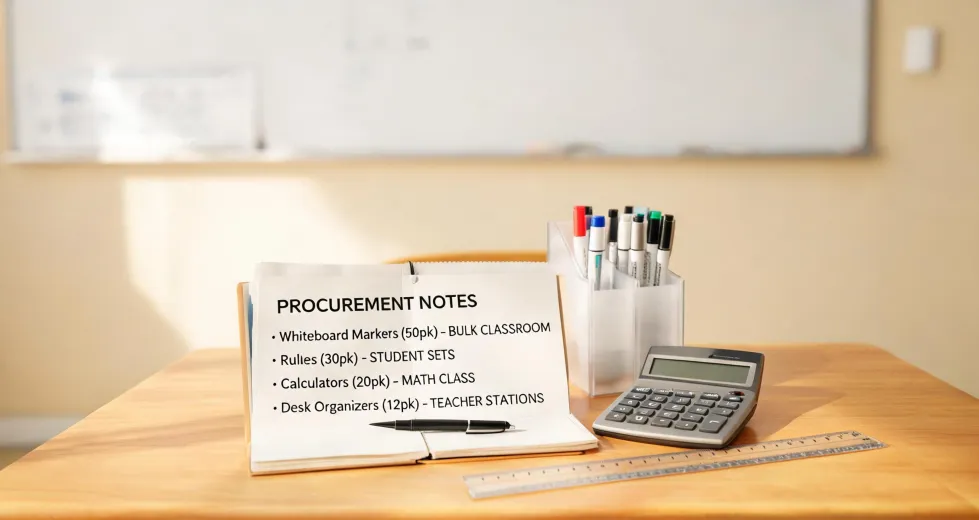
The local store wins when a teacher needs something in hand before third period. A few tape measures, one package of whiteboard markers, or a last-minute replacement ruler can be handled locally without waiting for a delivery. That is a legitimate reason to keep a local supplier in my rotation.
Why does this matter? Because an emergency purchase is not really about price. If a lesson depends on having measuring tools that day, the only thing that matters is whether the product is in the classroom.
Winner: no single winner. Online is better for planned bulk orders; local is better for urgent one-offs.
A side note on calculators and digital tools
One more comparison has nothing to do with products. Sometimes teachers ask for a calculator, but they do not mean a physical calculator.
Learning Resources sells the Primary Calculator, which is perfect for hands-on math practice. But if a test coordinator asks for an SAT score calculator, or a teacher wants a final calculator to help students project their semester grade, those are digital tools, not supply orders. In my first year, I searched supplier catalogs for these terms and came up empty. I ended up with a shelf of unused physical calculators because I did not ask enough questions.
Now I clarify the use case before I buy. If the request is for classroom math, I order from the Learning Resources shop. If the request is a digital scoring tool, I send a link and let the teacher test it before IT approval. It sounds obvious now, but it was a lesson learned the hard way.
When to use each: scenario recommendations
I will not say one route is universally better. Here is the thing: context decides.
Use the Learning Resources website when:
- You are ordering STEM kits, math manipulatives, Algebra Tiles Classroom Sets, or other curriculum-based materials in bulk.
- Finance needs itemized invoices and searchable order history.
- You have time for standard shipping and you want product documentation like whiteboard care instructions.
- You need to build a complete classroom solution rather than a single replacement item.
Use the local education supply store when:
- The order is one or two items and the teacher needs them today.
- You want to physically inspect a product before buying it.
- A grant or local purchasing policy requires you to support nearby vendors.
- The total cost is genuinely lower once shipping and handling are included.
Final takeaway
It took me four years and too many reconciliation spreadsheets to understand that the best supplier is not the one with the most recognizable logo. For me, the best supplier is the one that makes it easy to get the right product into a classroom without creating extra work for accounting.
For planned classroom purchases, the Learning Resources website is my default. It gives me deeper product options, clearer invoices, and useful documentation. But the local store still earns certain orders, especially small and urgent ones. I am not saying a math manipulatives bundle will guarantee higher test scores. I am saying that a supply order that arrives on time and invoices cleanly is something you control. In my job, that is the comparison that matters.