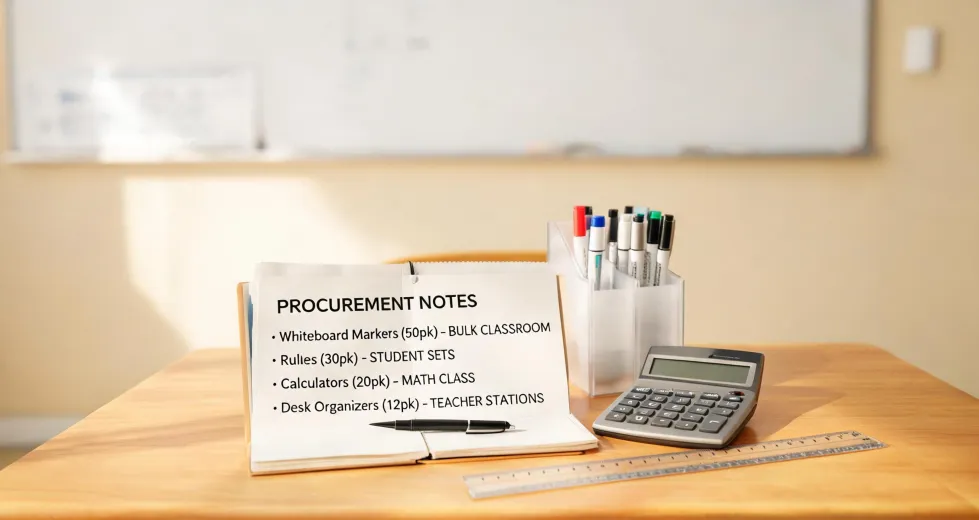
Student learning resources are any materials that help students understand a concept—not just textbooks. The best classroom purchases are classroom sets of durable, hands-on tools that students can touch, move, measure, and make things with. After 10 years of buying school supplies, I'd rather order 30 tape measures and 30 calculators than a shelf full of one-off kits.
I'm a procurement coordinator for a regional school supply distributor. I've processed 200+ rush orders over the last decade, including a 36-hour turnaround on 24 algebra tile classroom sets for a school that was about to lose a $12,000 grant. This guide is the advice I wish I'd gotten before I placed my first big orders.
What Counts as a Student Learning Resource?
Broadly, a learning resource is anything a teacher uses to support learning. That includes:
- Math manipulatives, like algebra tiles, counters, and base ten blocks
- Measuring tools, like tape measures and school rulers
- STEM kits and classroom bundles
- Pretend play sets that build social and language skills
- Classroom whiteboards for guided practice
- Calculators at the right level
- Art supplies—even if they don't look 'academic'
- Digital tools, including online calculators and interactive lessons
Notice I'm not saying 'worksheets.' The research and classroom experience point the same way: students learn best when they're doing something, not just reading about it. That's why the Learning Resources brand (and others like it) has earned a place in classrooms for more than 40 years—their products are designed for hands-on learning.
What Makes a Learning Resource Worth Buying?
When I first started in procurement, I assumed the cheapest option was always the right one. Then I had to reorder a 'budget' set of measuring tapes because three broke in the first month. The replacement cost wiped out the savings. I've since learned to ask three questions:
- Will it last one full school year? A slightly higher unit price is worth it if the product survives 180 days of classroom use.
- Can I get replacements quickly? We buy from vendors with reliable stock, not just low prices.
- Is it actually hands-on? Passive toys or digital games that don't require thinking are not the same as real manipulatives.
This sounds obvious, but it's where most orders go wrong.
Classroom Categories I Buy Again and Again
Math Manipulatives and Calculators
Algebra tiles are a no-brainer for middle school. A classroom 30-set is easy to store, easy to count, and versatile. I've watched an entire class finally understand factoring when they could physically arrange the tiles. For younger students, counters and base ten blocks are the go-to.
Calculators: Don't overthink it. A primary calculator is worth buying for every student in early grades. It teaches basic operations and—this is important—students will not likely try to use it to cheat on a test because it's designed for simple math. For high school, you need graphing calculators, but that's a separate conversation.
Measuring Tools
Every school needs tape measures and school rulers—and I mean real ones, not promotional freebies. A tape measure with markings that are easy to read and a lock that holds is essential. Buy a classroom set so you don't have to run around collecting rulers from other classrooms. In September 2024, we fulfilled a rush order for 30 tape measures for a teacher whose class was measuring the school garden. It took 90 minutes from call to delivery because the school was a local customer.
STEM Kits and Pretend Play
STEM classroom bundles are popular, but they vary widely. Some have too many small pieces. Some are basically one-session projects. Look for bundles with reusable parts. The National Association for the Education of Young Children (NAEYC) has long recommended play-based learning, and I've seen why. If you're buying for early childhood, pretend & play school sets are excellent for social skills. They look like toys, but they're student learning resources too. A child who plays 'teacher' practices vocabulary, sequencing, and empathy.
Art Supplies (Yes, They're Learning Resources)
If you're searching 'what are art supplies,' here's the short answer: art supplies are the materials used to make visual art. In the classroom, that's paint, brushes, paper, modeling clay, scissors, glue, and safety supplies. Art is not a separate 'extra'—it's a way to build fine motor skills and creative problem-solving. Buy in bulk, replenish consumables, and don't buy cheap scissors that don't cut.
Whiteboards and Display Tools
White dry erase whiteboards are one of the most useful classroom resources I know. A personal whiteboard for every student means the teacher can quickly see who's getting it and who isn't. I'd put them on the list before a lot of expensive tech.
Digital Learning Resources: Don't Overlook the Simple Ones
The best digital student learning resources are often the simplest. A future value calculator, for example, is an excellent tool for a personal finance unit. Students can change the interest rate and see compound interest grow in real time. A dew point calculator is the same idea for earth science—it turns an abstract formula into something students can use with data from their own weather station.
The International Society for Technology in Education (ISTE) standards emphasize using technology for creation and analysis, not just consumption. A future value calculator does that. A dew point calculator does that. An app that just tells students an answer does not.
One more thing about digital resources: if you searched 'new learning resources online high school diploma,' this article is probably not what you need. That phrase usually refers to online high school diploma programs, not classroom supplies. Those programs are legitimate, but they're not something a school supply distributor can help with. You need to check your state's approved education providers. I don't cover that here, and I don't pretend to.
Honest Limitations: When This Advice Doesn't Apply
There is no single perfect learning resource. If you're teaching high school physics, a pretend play school set is useless. If you're running a preschool, algebra tiles are a waste of money. These are all tools, and tools need to match the job.
If you're a parent buying for one child, skip the classroom packs. A single set of manipulatives is enough, and you don't need 30 whiteboards. If you're buying for a specialist classroom—like a woodshop or a science lab—you'll need different supplies than what I've described here.
Also, be careful with 'guaranteed' promises. I've never seen a learning resource that guarantees higher test scores for everyone. Anyone who tells you that doesn't understand classrooms. The best materials make good teaching easier; they don't replace it.
Final Verdict
For most K-8 classrooms, the highest-impact student learning resources are hands-on manipulatives, measuring tools, personal whiteboards, and a few well-chosen digital calculators. Buy durable classroom sets, choose products from trusted educational brands, and replace consumables before they run out. That approach has served our schools better than any flashy one-time kit.
This guide reflects what I've learned as of February 2025. The school supply market changes fast, so verify current products and pricing with your vendor before ordering. And if your situation is different—high school, home use, or a specialized program—don't force this advice. Find resources that fit your actual classroom, and ask a real teacher what they need.