
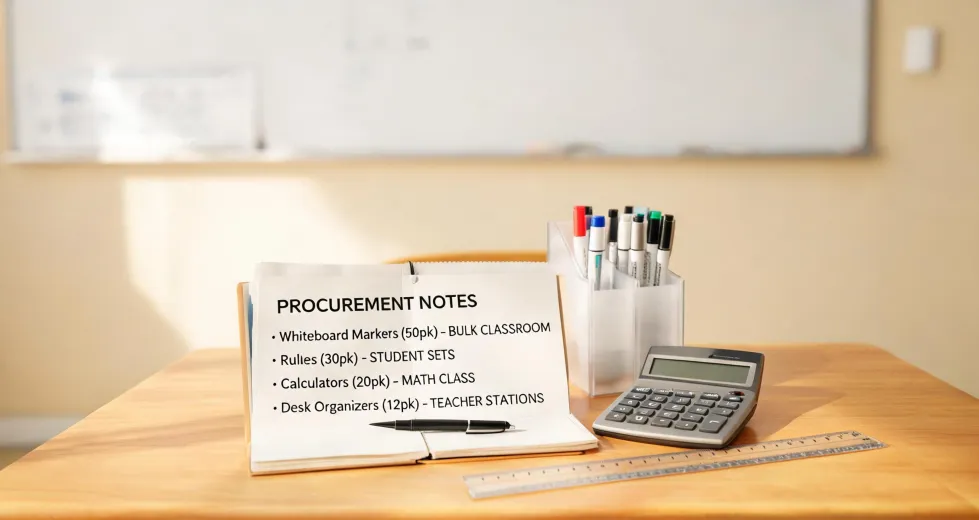
There is no single 'best' Learning Resources order. I know that sounds like a cop-out, but after seven years of buying classroom materials for my school, I've learned the hard way that the right call depends on who's using the materials. A kindergarten teacher and a middle school interventionist need completely different tools. Ordering for both without a clear plan is how you end up with a closet full of algebra tiles nobody touches.
I'm the teacher who made that mistake. In my first year (2017), I submitted an order for algebra tiles because the catalog photo looked like what a 'math classroom' should have, not because my 4th graders were ready for variables. That set sat unused for a year. I've made (and documented) roughly 11 significant ordering mistakes since then, totaling about $2,800 in wasted budget. Now I maintain our school's checklist so other teachers don't repeat my errors.
The point isn't that one Learning Resources product is better than another. It's that your situation changes the answer. This guide follows the decision tree I wish I'd had back then.
The Three Ordering Scenarios I See Most Often
In my experience, most classroom orders fall into one of three categories:
- Scenario A: Early elementary (PreK–2). You need counting, sorting, patterns, pretend play, and basic measuring tools.
- Scenario B: Upper elementary (3–5). You're teaching fractions, geometry, early algebra, and hands-on STEM units.
- Scenario C: Middle school, high school, or intervention. You're working with small groups, filling skill gaps, or preparing students for specific tests.
Before we go further, note this: the Learning Resources catalog (learningresources.com) is where I start, but I no longer search by category first. I search by student need. The age and skill labels are there for a reason. I ignored them once, and it cost me.
Scenario A: PreK–2 — Hands-On First, Calculation Later
If you teach young students, your best bets are resources that let kids touch and sort as they learn to count, compare, and describe the world. For this group, I'd start with counting and sorting manipulatives, pretend play sets, simple measuring tools, and a few classroom whiteboards for showing work.
The Learning Resources Primary Calculator is also worth having, but it's not the main event in PreK–2. Young kids need the physical experience first — the calculator can wait until they understand what the numbers mean. What I mean is, a calculator is a tool, not a teacher. It should support a lesson, not replace the thinking.
This is also where I learned my grade-label lesson. When I compared the PreK–2 section and the 3–5 section side by side one afternoon, I finally understood why the same catalog can have wildly different suggestions. The same product can be perfect for one age and useless for another — but only if you know what to look for.
Scenario B: Upper Elementary (3–5) — Build the Visuals
Third through fifth grade is, in my opinion, the sweet spot for hands-on math. Fractions, area, perimeter, beginning algebra, measurement, and basic coding all become more concrete when students can touch the parts. According to the National Council of Teachers of Mathematics (Principles to Actions, 2014), effective instruction uses multiple representations — including physical manipulatives — to support conceptual understanding. That's the whole reason these products exist.
For this group, I look for fraction manipulatives and number lines, algebra tiles as a 30-set classroom bundle, STEM kits that connect to a specific unit, and sturdy measuring tools — not the cheapest ones. One fall, I saved about $20 by ordering generic plastic tape measures. By October, eleven of them were broken, and replacing them cost $85. That's the most expensive way to save money.
The algebra tiles I bought in 2017 sit in our storage room to this day. I kept them because they're actually great — but only for students who understand variables. If you're not sure, use the teacher professional learning resources in the catalog to find a sample lesson first. If a resource doesn't support a lesson you're about to teach, it's not a good buy, no matter how nice it looks in the photos.
Scenario C: Middle School, High School, and Intervention — Think Targeted
For older students, the goal shifts. You're not building foundational math from scratch as often. You're filling gaps, making abstract concepts visible, or preparing students for benchmarks. This is where a class set of algebra tiles, geometry tools, and coordinate grid whiteboards start to make sense.
This is also where I need to clear up a common source of confusion. When someone types 'calculator' into a search bar, they might see a gematria calculator, an SAT score calculator, or a rent vs buy calculator. Those are useful in their own ways, but they are not the same category as a classroom calculator. A gematria calculator is for number-letter interpretation. An SAT score calculator estimates test scores based on practice data — handy for tutoring, but not a manipulative. A rent vs buy calculator is a personal finance simulation, which can be a great discussion activity for older students, but it's a digital tool, not a hands-on resource.
If you want a physical calculator for elementary or early middle school, the Learning Resources Primary Calculator is my standard recommendation. It's simple, durable, and doesn't have twenty functions kids will never use. According to the Learning Resources catalog (learningresources.com), it's designed for younger learners, and the price has stayed reasonable for school budgets (typically under $15; verify current pricing before you order).
That said, I'm not anti-digital. Online tools have a place, especially for older students. I use an SAT score calculator when I'm tutoring, and a rent vs buy calculator can be a smart way to teach real-world math. But those are different from the 'buy a physical product for your classroom' decision. Don't let a search engine convince you otherwise.
How to Tell Which Scenario You're In (Without Guessing)
If you're still not sure, ask yourself three questions.
- Who is actually using this? If the answer is a whole class of 25, buy class sets. If it's a small intervention group, you can afford to be more targeted.
- What skill are you teaching this month? The resource should support a specific lesson, not a vague 'future readiness' idea. If the lesson isn't already planned, the resource can wait.
- Where will it live? No storage? Then buy fewer, higher-quality items and rotate them between classrooms.
After the third wrong-size order in Q1 2024, I created a pre-check list. It's just a spreadsheet: item name, grade level, quantity, teacher name, lesson tie-in, and a 'SUCCESS' note when it's been used. Since then, the spreadsheet has caught 47 potential errors in the past 18 months. It also cut our order review time from two days to about two hours. Why does that matter? Because the extra time goes back into planning, not procurement.
One more thing. A year before the algebra tiles, I told our principal we needed to 'stock up on math materials.' She heard 'order more workbooks.' We got 30 workbooks nobody used. We were using the same words, but we meant different things. So now, with every order, I write out exactly what students will do with the resource. If it's not clear, I don't order it.
In other words, the best Learning Resources order isn't the biggest one, or the most popular one, or the one with the prettiest catalog photo. It's the one that matches a real student need, a real lesson, and a real storage shelf. If you're not there yet, start with the catalog, use the questions above, and don't let anyone talk you into algebra tiles for 1st graders.