
Here's a sentence that gets me in trouble: the sticker price on learning resources is the least interesting number on the page. I know that sounds dramatic. I mean it—every word.
I'm a quality and brand compliance manager at an educational resources company. I review 200+ unique products a year. In 2024, I rejected 6% of first-pass deliveries over issues like dimensional tolerance and color consistency. I've spent four years measuring plastic tiles, testing dry-erase boards, and saying no to samples that looked fine in a photo but failed in a classroom. So when I say schools are buying learning resources wrong, I'm speaking from experience, not theory.
I didn't always think this way. I only became a total-cost believer after ignoring the advice and eating the consequences. A supposedly cheaper supplier's product failed in the field. The rework and rush shipping cost us more than the 30% price differential we thought we were saving. That lesson changed how I review every purchase.
A price tag is a down payment
A unit price is just the down payment. Total cost of ownership includes shipping, setup, teacher training, replacement, disposal, and the time wasted on products that don't work. That last one is the biggest hidden cost in education.
In Q3 2024, we received a component batch where the finish was visibly off. Normal tolerance for that spec is 0.2 mm. The vendor said it was “within industry standard.” We rejected the batch. The redo cost $22,000 and delayed a launch. The buyer saved $0.30 per unit on the component. They paid for it many times over in inspection, expedited freight, and phone calls.
That was the moment I became the annoying person who asks “what's the replacement rate?” before “what's the price?”
The algebra tiles example
Consider an Algebra Tiles Classroom 30-Set. It's a staple in middle-school math. It looks simple: a tray and tidy rows of square, x, and y tiles. If the tile thickness drifts by even 0.3 mm, the pieces don't sit flush. Students stop thinking about polynomials and start fiddling with plastic. A cheap version doesn't look cheap in a catalog photo. It looks identical, until it's in a student's hand.
According to the National Center for Education Statistics (nces.ed.gov), per-pupil spending in U.S. public schools has topped $15,000 in recent years. When you're spending at that level, saving $2 on a math manipulative is not a win. It's the kind of choice that costs a 20-minute lesson.
If you can't decide between two options, buy one set and pilot it before you scale. A pilot test is cheap. A classroom set failure is not.
Teacher time is the cost we don't write down
Let me sound like an accountant for a moment: calculate teacher time. If a classroom set arrives with 10% unusable pieces, someone has to sort them. If that takes 30 minutes, it's not just 30 minutes—it's 30 minutes of a licensed educator's time. Over a semester, those small failures add up to hours.
This is where I tell procurement teams to get familiar with an overtime calculator. Yes, that's a financial tool. But it works for classroom supplies too. I've used an overtime calculator to estimate the real cost of a “cheap” purchase: extra hours, rush replacement orders, and the emotional tax of hearing a teacher say “it just isn't worth it.” The savings disappeared in the first month.
You can also think in future value terms. A $300 set of manipulatives that lasts five years is cheaper than a $150 set that lasts one year. I'm not saying you need a future value calculator to make this call. But if a future value calculator helps your budget committee see that long-term use matters more than invoice price, then use it.
The pixel art trap
Another example: our Pixel Art Challenge learning resources kit. It's a grid-based activity with hundreds of tiny colored tiles. Kids love it. But if the tiles aren't uniform, the grid doesn't snap together, and the challenge becomes a frustration drill. A low-cost version that saves $2 per kit is false economy when a teacher eventually throws it out after six uses.
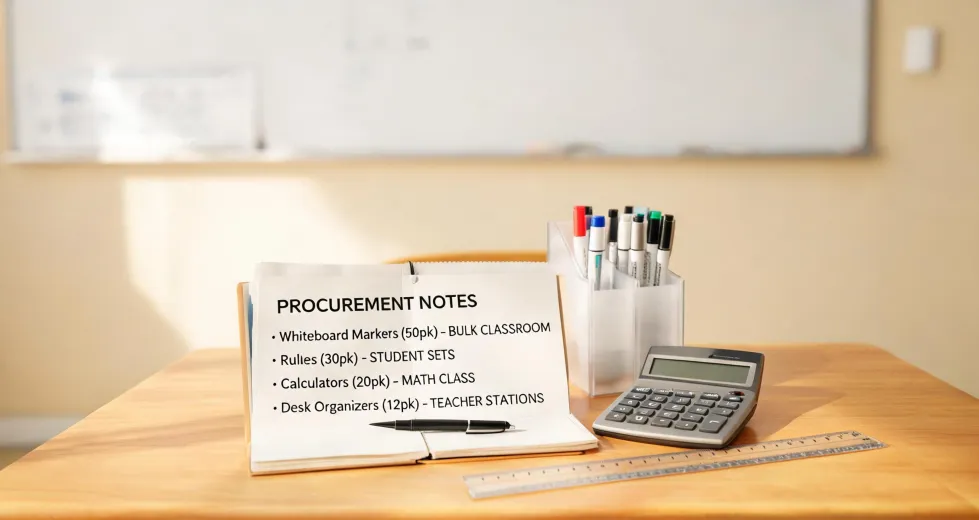
I apply the same reasoning to classroom basics. The white dry erase whiteboards we sell specify a certain backing density because cheap boards warp in humid classrooms. A warped board doesn't get repaired; it gets replaced. A primary calculator that survives a four-foot drop costs a few cents more to make than one that shatters on the second week. Those are the costs that don't appear on the purchase order.
Those failures don't always show up in accounting. They show up as missing materials, frustrated students, and teachers using their own money to fill the gaps.
“But the budget is tight.”
“We would love to consider total cost, but we have $500 and we need a full classroom set next week.”
I hear that. Budget constraints are real. But total cost thinking doesn't mean ignoring the budget. It means asking smarter questions inside it.
Honestly, I've been on the other side of this. I went back and forth between a proven supplier and a new one for two weeks. The proven supplier offered reliability; the new one offered 25% savings. The expected value said go for the savings, but the downside felt catastrophic: a $3,500 redo, a missed deadline, and a classroom without supplies. I chose reliability. It wasn't exciting. It was right.
The same principle applies in tax planning: a married filing jointly vs separately calculator doesn't tell you to spend more money; it tells you whether your choices interact in the most favorable way. A married filing jointly vs separately calculator looks at both incomes, deductions, and liabilities together. A total-cost mindset looks at price, durability, replacement, and teacher time together. The structure of the purchase changes the final number.
I've also seen this mindset at the university level. The SJU Office of Learning Resources, for example, supports students across a campus where materials get heavy daily use. They don't need gimmicks; they need resources that survive tutoring appointments. That's the perspective I'd love to see in every district purchase order.
The 5-minute TCO check
So here's my unpopular recommendation: stop comparing unit prices. Compare five numbers instead:
- Unit price, including shipping and handling.
- Replacement rate over a school year—if you don't have a number, ask the vendor or run a pilot.
- Teacher time required to sort, supplement, or replace missing pieces.
- Expected lifespan and storability in real classroom conditions.
- Setup and training time.
That's it. You don't need a spreadsheet the size of a tax form. You need a product that works on day one and day 200.
At Learning Resources, I'm the first to admit we're not the cheapest option. I'm also the person who rejects our own samples when the thickness is off. The products that reach classrooms are the ones I'd want in my own child's hands. That's the standard. I think every child deserves resources that don't fall apart, and every teacher deserves materials that save time rather than waste it.
Take it from someone who measures plastic tiles for a living: the best deal isn't the one with the lowest price. It's the one with the lowest total cost. Calculate that, and the buying decision becomes much easier.