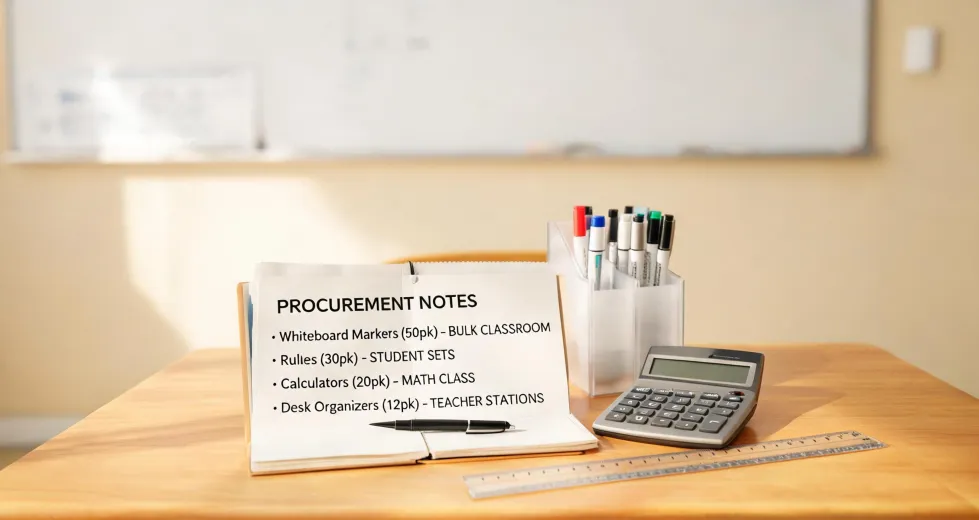
Look, I'm not going to sugarcoat it: small schools get treated like second-class customers. I'm the procurement manager at a 115-person private K-8 school. I've managed our instructional supplies budget—$140,000 annually—for 8 years, negotiated with 60+ vendors, and documented every order in our cost tracking system. In that time, I've learned that a small order often triggers a weird response: slower quotes, higher per-unit prices, hidden fees, and a general vibe that you're wasting someone's time.
Here's the thing: that attitude is both wrong and short-sighted. The vendors who took my $200 orders seriously are the same ones I now trust with $20,000 orders. Small doesn't mean unimportant. It means potential.
What the numbers actually say
When I audited our 2023 spending, I found that 23% of our budget overruns didn't come from buying too much. They came from buying from vendors who added fees for small accounts. One supplier charged a $25 low-order handling fee on every order below $75. Another quoted list price to us while giving a 12% discount to a nearby district for the exact same Learning Resources products.
That's not a small-order problem. That's a transparency problem.
I learned this the hard way. In my first year, I made the classic specification error: I assumed standard meant the same thing to every vendor. I ordered a standard classroom set of fraction manipulatives from a low-price vendor. The pieces didn't match our curriculum's alignment, and I had to redo the whole thing. Cost me a $600 redo and a very awkward meeting with a math teacher. A lesson learned the hard way.
After getting burned twice by hidden fees, I built a TCO calculator in Google Sheets. Now every quote goes into the same template: unit price, shipping, handling, minimum-order fees, expected lifespan, replacement cost. That single spreadsheet has saved us more money than any vendor discount.
Small orders shouldn't mean small effort
Honestly, some vendors are amazing with small schools. But the ones that treat a $300 order like a favor? Red flag.
Let me give you a concrete example. In 2023, I compared costs across 8 vendors for a STEM classroom bundle. Vendor A quoted $85 per set. Vendor B quoted $64. The spreadsheet said go with B. My gut said something felt off about their responsiveness. I almost went with B until I calculated total cost of ownership. B charged $32 freight, a $20 processing fee for orders under $500, and a separate handling fee per line item. Total? $116. Vendor A's $85 included everything. That's a 36% difference hidden in fine print.
So bottom line: the unit price is not the price. For a small school, every dollar counts. When I see a vendor add a small-order surcharge, I walk. It's not that the surcharge is always unreasonable—it's that it's usually not disclosed until checkout. That's a deal-breaker for me.
Hands-on learning resources are core inputs, not extras
I sometimes hear procurement people say, let's cut the fun stuff. But in a K-8 school, hands-on learning resources are not fun extras. They are the curriculum. Educators have trusted Learning Resources for 40+ years, and I see why: the hands-on design is consistent, the kits are durable, and the range covers math manipulatives, STEM kits, pretend play, measuring tools, and classroom whiteboards under one roof.
Take pixel art learning resources, for example. I used to think they were a fast-finisher activity. Then I watched a fifth grader finally understand coordinate pairs because she was placing colored squares on a grid. That's not play. That's the concept landing. We now buy a class set every year. It's a no-brainer.
Same story with financial literacy. Our PreK teacher asked for the Pretend & Play school set so she could use the student cards with financial learning resources during morning choice. Those little cards—plus a toy register—taught more about coin values and making change than a $1,000 software license. I should know: I approved both in the same quarter, and the $28 set got used twice as much.
If you're ordering printed student cards, ask for 100 lb cover stock. That's about 270 gsm, roughly the weight of a good business card. 20 lb bond copy paper won't survive small hands. And if you're printing custom pixel art grids, request 300 DPI at final size. Below that, the squares get fuzzy, and kids get confused. For color-coded cards or grids, ask for Pantone references if you can. According to Pantone Color Matching System guidelines, a Delta E of under 2 is ideal for brand-critical colors. Those standards matter more than people think.
Calculators are tools. Concepts need something more.
Last year, a middle school teacher put in a request for a mean median mode calculator. I almost ordered one. Then I talked to a veteran teacher who said something that changed my perspective.
If kids can't see the numbers move, a calculator just hides the confusion.
We bought a class set of mini whiteboards and a set of algebra tiles instead. Students write out the data, physically sort it, and only then push the buttons. The calculator would have been a shortcut to nowhere. For older students, a cumulative GPA calculator is a fine time-saver for counselors. But for teaching the actual concept? Hands-on first.
Since we're on the topic of whiteboards: the most common teacher question in our school is not about budgets. It's how to remove dry erase marker from clothes. The answer that actually works: isopropyl alcohol or hand sanitizer, rub it in before the stain sees hot water, then wash normally. Source: years of trial, error, and one very stained shirt.
What about the small-order premium?
I can already hear a sales rep saying, but small orders have higher per-unit costs. It's just economics. Sure. I'm not asking for identical unit pricing. That would be naive.
What I am asking for is honesty and respect. If a $75 order costs a vendor $10 to process, tell me. Don't hide it. Don't add a handling fee at the last screen. And don't make me wait three weeks for a quote while a district with 50,000 students gets a response in 24 hours. The most frustrating part of small-school procurement is that the same issues recur despite clear communication. You'd think a written PO would be enough, but interpretation varies widely.
In Q2 2024, we switched a vendor for our classroom whiteboard line. The new vendor didn't offer the lowest unit price. But they quoted fast, shipped on time, and treated our 15-unit order the same way they treated the big district down the road. Switching saved us $8,400 annually—17% of our budget—mostly by eliminating rush-shipping emergencies that came from being deprioritized.
Even after choosing the new vendor, I kept second-guessing. What if the quality wasn't as good as the samples? The two weeks until delivery were stressful. Then the boxes arrived on time, correct, and complete. Not one surprise fee. That's rare.
That's not a small win.
My bottom line
I've been tracking every invoice for 8 years. I've analyzed $180,000 in cumulative spending. I've been burned by hidden fees and saved by honest vendors. And I still believe the same thing: small schools deserve good service and fair pricing.
If you're a school like mine, don't apologize for your order size. Ask the total-cost questions. Ask for 300 DPI. Ask for 100 lb cover stock. Ask for the price including delivery. And if a vendor makes you feel like your $300 order isn't worth their time, find another one.
Today's small order is tomorrow's annual contract. You don't want to be the vendor that was too busy to notice.