I'm the office administrator for a small private school, which means I do the ordering: math manipulatives, tape measures, whiteboards, STEM kits, you name it. My annual purchasing budget is roughly $60,000, and I manage it across about eight different vendors. When a new teacher asks me 'what are school supplies?', I usually have to sit them down.
The simple answer is pencils, notebooks, glue sticks. But that's not the whole answer. There are several types of learning resources in education—hands-on manipulatives, printed materials, digital tools, and real-world objects. The best classrooms use a mix. The right mix, though, depends on your situation.
So instead of giving you one checklist, here's the framework I use. It has three branches.
Scenario 1: Early Childhood Classrooms
If you're buying for PreK or kindergarten, the core of a learning resources school set is hands-on play. Think counting bears, sorters, pretend food, and dress-up items. These aren't toys in the 'fun' sense—they're the tools that teach number sense, vocabulary, and social skills.
If you've ever bought a pretend play set, you know the price range is wide. I went back and forth for two weeks between an inexpensive play kitchen set and a better-made one from Learning Resources. Numbers said the budget option made sense. My gut said the cheap set would look worn out by October. I went with the better-made set. Not because we're fancy—because parents judge a school by what their kids touch. A classroom is the product. Spend accordingly.
Quality isn't about luxury. It's about image. A chipped plastic plate or a faded play food label sends a message about the whole school.
Scenario 2: Elementary Classrooms
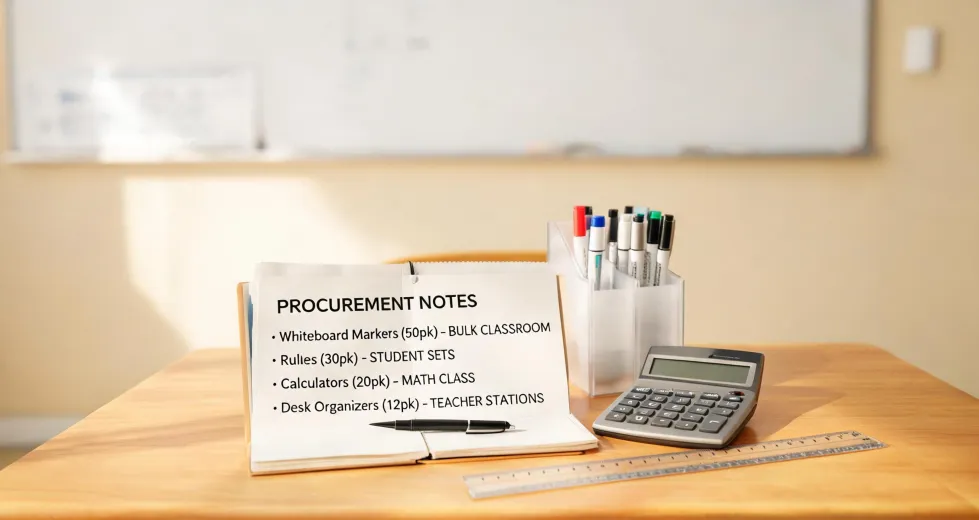
For grades 1 through 5, the purchasing list changes. Now you're looking at whiteboards, measuring tools, calculators, and math manipulative sets. The 'what are school supplies' answer becomes: supplies that do one job and survive a hundred hands.
Take measurement. A tape measure, a school ruler, a primary calculator—these are the physical bridge between math and the real world. A digital cubic feet calculator is useful if you're checking your own volume math during lesson prep. But it's not a teaching tool for most elementary students. They need to hold a tape measure, press buttons, and accidentally drop it a few times.
Cheap calculators worry me. Last year I bought a carton of basic calculators that looked fine on paper. Three broke in the first month. The Learning Resources primary calculators we'd used in a different classroom were still going after two years. I'm not 100% sure why—better buttons, better casing, maybe—but the pattern was clear.
If you're printing posters or flashcards, this is where a different kind of standard matters. I learned this the hard way with a set of classroom posters that arrived curled. Now I check paper weight before ordering. For anything displayed on a wall and touched by students, I look for 80 lb cover stock—roughly 216 gsm. And if I'm printing my own labels or visuals, I ask for 300 DPI at final size. These are industry details most people don't think about, but they're the difference between 'professional classroom' and 'clipboard on a nail.'
Scenario 3: STEM, Middle School, and Specialized Classes
By middle school, the best types of learning resources in education change again. Instead of simple manipulatives, you need tools that model systems: algebra tiles, classroom STEM bundles, measuring equipment, and kits that support a specific curriculum.
This is also where digital resources can be useful. If you're teaching volume, a cubic feet calculator can help students verify their calculations. For a nutrition or data unit, a chipotle calorie calculator can make a surprisingly good hook for a lesson about ratios—older students care about food, and that's a real dataset. But I'd argue these are supplements, not the main resource. They depend on wifi, ads, and whoever maintains the website. A physical learning resources school set is the reliable backbone.
When I ordered algebra tiles for our middle school, I went back and forth between a budget option and the Learning Resources classroom 30-set. The budget option was significantly cheaper. The Learning Resources set was more expensive but came in a sturdy storage box and had a teacher guide that aligned with our math framework. I chose the classroom set. If you ask me, a teacher is a lot more likely to use a resource that's organized and ready to go. That's the kind of quality that pays for itself.
Quick note: this article reflects what I knew in the 2024–25 school year. Product lines change, supply chains change, and safety standards get updated. Always verify current listings and vendor policies before you commit a budget.
How to Know Which Scenario You're In
If you're wondering which of these branches fits you, don't start with a product list. Start with two questions.
- What age group are you buying for? PreK and kindergarten need play-based resources. Elementary needs durable, hands-on tools. Middle school needs system-level kits and specialized items.
- What type of learning are you trying to support? A reading intervention room needs different supplies than a STEM lab. A general classroom needs a mix.
From there, you can build your own version of a learning resources school set. There isn't a universal answer to 'what are school supplies.' There is an answer that works for your situation.
Take it from someone who orders classroom supplies for a living: the extra minute spent matching resources to your actual space is worth more than another 'all-purpose' checklist.