
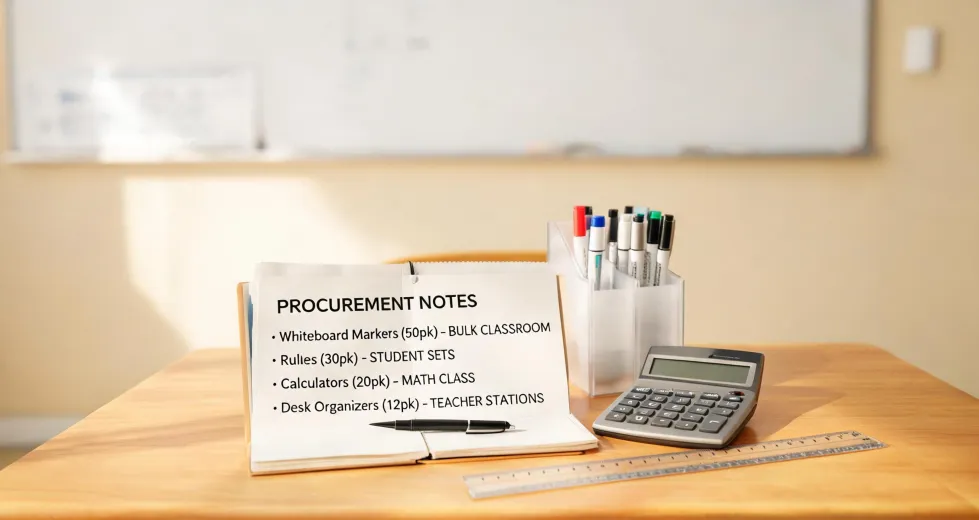
Here's a scene I see too often: a teacher opens a fresh class set of algebra tiles, and three of the plastic storage bags are already ripped. Inside, the tiles themselves look fine—until a student tries to build an area model and the pieces slide apart because the edges aren't square. The school saved $200 by choosing the lower bid. Now the lesson is gone, the teacher is frustrated, and the procurement cycle starts all over again.
I'm a quality and brand compliance manager at an educational resources company. I review roughly 200+ unique items a year before they're shipped. In Q1 2025, I rejected 7% of first deliveries—not because vendors are malicious, but because 'close enough' is not a specification. This isn't a story about buying premium products. It's about buying truth.
When schools evaluate a purchase, they often use an ROI calculator for big-ticket items, or a cap rate calculator for facilities projects. But for student learning resources, the calculation is usually just 'cost per unit.' That's a mistake. Let me unpack it.
The Problem That Looks Like a Budget Problem
From the outside, the problem looks like money. School budgets are tight. Procurement officers get pressure to cut line items. Parents see 'higher quality' as 'fancier packaging.' I get why the cheapest option often wins—budgets are real. But the surface problem is not the price. It's the difference between the number on the purchase order and the total cost of ownership (i.e., what it actually costs after breakage, replacements, and lost teaching time).
People assume the lowest quote means the vendor is more efficient. What they don't see is which costs are being deferred. The $0.99 ruler can be $0.99 because it's made with thinner plastic and a less accurate mold. It measures fine on day one. By October, it starts splitting at the hole. By January, you're buying more rulers.
What I Learned Comparing 'Identical' Learning Resources
When I compared two 'identical' STEM classroom bundles side by side—same 30-set count, same product name, same color-coded key—I finally understood why the cheap option usually costs more. One set had teacher guides with matte, tear-resistant covers and a clear scope-and-sequence document. The other had glossy pages that curl in humidity and a one-page 'instruction sheet' that assumes the teacher already knows how to teach fractions. Both said 'classroom bundle,' but they were not the same product.
I see this all the time in primary calculators. A 'primary calculator' can mean a basic four-function device with small plastic keys, or a carefully designed tool with a large LCD, a sloped face, and oversized operation buttons that line up correctly. From the outside, the difference is subtle—kind of like comparing a $10 pair of scissors to a $3 pair. The specs are where the truth hides.
Here's the thing about school education learning resources: they are not commodities. A box of algebra tiles might look uniform, but the tile thickness, the plastic type, and the edge tolerance matter. I've learned to ask 'what's NOT included' before 'what's the price.' Because the vendor who lists all fees upfront—even if the total looks higher—usually costs less in the end.
The Hidden Specs That Matter (But Nobody Puts in the P.O.)
Let's get specific. When you're evaluating learning resources, don't just trust the product photo. Ask for numbers. For color-coded fraction tiles, ask about color tolerance. The commercial print standard is Delta E < 2 for brand-critical colors; a similar threshold works for plastic manipulatives. If red and orange are hard to distinguish after a month of use, that's not an aesthetic issue—it's a math lesson that silently fails.
For measuring tools, ask about the blade material and the hook end. A 60-inch tape measure made for kids shouldn't need a physics degree to stay extended. Rulers should have a specified thickness and a 'no-slip' serration if they claim it. Whiteboards should have a surface that erases cleanly; if a marker leaves ghosts after 10 uses, the board wasn't made for school use.
And if a vendor makes a claim—'improves engagement,' 'supports Common Core,' 'tested in classrooms'—ask for the evidence. Per FTC advertising guidelines, claims have to be truthful and substantiated. That's not a legal nicety; it's a filter. Good vendors can point to the research. The rest get quiet.
What a Bad Learning Resource Really Costs
I'll give you an example from our quality history. A vendor offered a class set of plastic counting pieces at a price that undercut every other bid. The sample passed—barely. The full batch of 8,000 pieces didn't. The plastic was thin enough to flex in ways that affected stacking. The vendor said it was 'within industry standard,' but normal tolerance was 0.1 mm, and we measured 0.3 mm off in some pieces. We rejected the batch, and a replacement arrived three weeks later. For a school, three weeks is not a delay. It's a semester that doesn't happen. The 'savings' disappeared and on paper, the redo cost us about $1,400 in internal time and shipping—plus a teacher who had to improvise. (note to self: never trust a sample from a vendor who won't commit to a pilot run.)
That's the penny-wise, pound-foolish pattern. People think expensive learning resources are expensive because quality is expensive. Actually, it's the reverse. Vendors who deliver consistent quality can charge more—the price is the result of consistency, not the cause. The cheap product doesn't lower the cost; it shifts the cost to a later invoice, one that's never itemized.
If you ran an ROI calculator on this scenario, you'd probably find that the original cheaper purchase had a negative return. The problem is, no procurement system connects that failed class set to the $1,400 in staff time. The calculator can't see what happened. It only sees the unit price.
I'd also point out that the same logic applies to the materials you print at school. Knowing how to get printer online might sound unrelated to math manipulatives, but I've watched a teacher give up a 25-minute lesson because the worksheet wouldn't print. Learning how to get printer online is a real operational skill—it saves teaching time, and teaching time is the most expensive part of any learning resource. (I really should write this on the IT help desk poster.)
A Short, Unfashionable Solution: Transparency + Verification
So what do I recommend? Not necessarily spending more. I recommend asking better questions and demanding transparent numbers. A short checklist:
- Write specifications with numbers: material, thickness, weight, dimensions, drop-test result, color tolerance. If the only specs are 'premium' and 'durable,' the purchase order is a wish, not a contract.
- Ask for a preproduction sample, then measure it. Don't just look at it. Weigh it. Flex it. Try to make it fail. The product that survives a 30-second field test will probably survive a school year.
- Request all fees in writing before you sign. The final total should be the actual total. If a bid says $4,500 and the final invoice is $5,100 because of 'handling,' 'shipping,' and 'data management,' that's not transparent—it's a hidden fee.
- Check the postal math if you're mailing printed guides or remote learning kits. According to USPS pricing effective January 2025 (usps.com/stamps), a First-Class Mail large envelope costs $1.50, and a letter costs $0.73. On 30-student orders, shipping is not an afterthought—it's part of the unit cost.
I'm not saying every budget bid is bad. To be fair, some low-priced learning resources are perfectly fine for the right context. But the only way to know is to verify—and transparency is the fastest verification tool. The vendor who lists all fees upfront, who gives you a measurable spec, and who answers 'what's not included' without hesitation has never wasted my budget. The one who dodges questions is probably hiding something. (mental note: that's the last sentence I ever want to be right about.)
The real cost of school education learning resources isn't on the first invoice. It's in the second, third and fourth orders, the lost lessons, and the teacher time spent making do. A defensible purchasing process isn't about being strict—it's about being clear. Clarity is the most underrated quality control tool I know.