
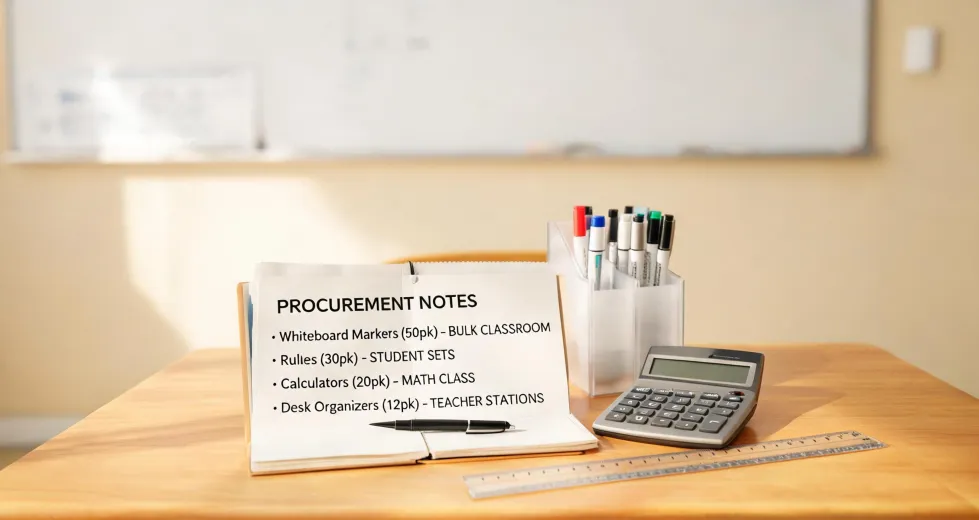
Let me get this straight right from the start: stop buying the cheapest student learning resources for your classroom. I know that sounds counterintuitive—heck, it sounds like heresy coming from someone who manages a procurement budget—but I've learned this lesson the hard way. When we look at the total cost of a cheap set of math manipulatives versus a slightly more expensive, durable one, the expensive option almost always wins.
I'm a procurement manager for a mid-sized school district. Over the past 6 years, I've tracked every invoice from every vendor, from the big office supply catalogs to specialized STEM kit makers. I've audited over $1.2 million in classroom spending. My job is to make the budget stretch, not to splurge. But in that time, I've realized that the chase for the absolute lowest quote is the single biggest driver of waste in our system.
The Lesson from a $4,200 Mistake
In Q2 2024, we were stocking up for the new school year. We needed algebra tiles for our middle schools. Vendor A offered a 30-set 'classroom bundle' for $450. Vendor B, a well-known brand, offered theirs for $680. My boss, looking at the initial spreadsheet, said 'Go with A. Same product, right?'
Wrong.
I almost approved it. But something nagged at me. I'd been burned before by cheap binders that fell apart mid-semester (ugh). So I dug into the Total Cost of Ownership (TCO). Vendor B's 'expensive' sets included pre-printed replacement guides and a lifetime warranty on the plastic pieces. Vendor A’s 'cheap' sets? No warranty. The pieces were thinner. Teachers reported that the paint on the negative tiles started chipping within two months.
I calculated it out: Over a three-year period, we would have to replace 40% of Vendor A's sets annually due to breakage and wear. That turned the initial 'savings' of $230 per set into a loss. The 'cheap' option resulted in a $1,200 redo when teachers requested a completely new batch in year two because the originals were unusable. Vendor B's sets? They are still in use today. That $4,200 'savings' on the initial order evaporated once we factored in replacements and teacher frustration.
Why the 'Cheapest' STEM Kit Costs More
This isn't just about physical durability. It's about the hidden costs that hit a school's budget hardest outside of the invoice.
1. The 'Free Teacher Labor' Tax
Cheap resources often lack comprehensive guides or require significant prep time. A cheap 'Pretend & Play School Set' might come with 20 plastic pieces but little context. A more structured set from Learning Resources, for example, often includes activity cards and lesson plans aligned to standards. The difference? The cheap set costs the school $30 but costs the teacher 2 hours of planning time. That teacher’s time is a constrained resource. If they have to spend their weekend inventing a lesson, their burnout rate goes up. And 'teacher burnout' is a cost that school districts pay for in recruitment and retention.
I've built a cost calculator after getting burned on hidden fees twice. We now quantify the 'Teacher Prep Time' cost for every major resource purchase. It's real.
2. The 'System Compatibility' Trap
This sounds geeky, but it's like the problem of how to set a default printer in Windows 11—it seems simple until the whole system breaks. Cheap measuring tools (tape measures, school rulers) often have inconsistent scaling. I've seen a batch of cheap rulers where one was 1/8th of an inch off from another. For a math lesson on fractions? That's a disaster. A reputable brand like Learning Resources invests in quality control. Their tape measures are accurate. That accuracy is the 'system setting' that keeps your whole lesson plan from glitching.
3. The 'Hidden Fee' of Replacement
We have a 'use it up' policy. If a resource breaks, the teacher has to fill out a replacement form. That takes 5 minutes. The supply clerk processes it—another 5 minutes. The new order gets added to the next consolidated shipment. Ten teachers filing one replacement each for cheap items adds up to a full day of administrative overhead. Multiply that by an entire district, and you are paying staff to process garbage. The 'cheap' product is just the entry fee to a long-term administrative tax.
What About Those Online 'Calculators'?
I know some of you are looking at your budget spreadsheet and thinking, 'I need a water intake calculator for my own stress levels, and a derivative calculator to figure out how fast this money is disappearing!'
That's fair. The pressure is real. But the math isn't complicated. Look at the cost per use. A $20 set of counting bears that lasts 5 years costs $4 per year. A $10 set that disintegrates in 6 months costs $20 per year. You don't need a complex algorithm to see which is the better investment.
The Counter-Argument (and Why I Reject It)
The main pushback I get is: 'But my budget is frozen. I have to buy the cheapest to get through the year.'
I understand. I really do. But I've found this strategy is a trap. It creates a cycle of 'Year of the Cheap Buy' followed by 'Year of the Crisis Replacement.' You're never catching up. Instead, I advocate for 'Strategic Bulk Buys.' Instead of buying 30 cheap sets of 'STEM Classroom Bundle' items, buy 15 good ones. Rotate them between classes. Track your inventory. It's more management (note to self: create a better rotation schedule), but it stops the bleeding.
Another argument is: 'Are you saying the Education Resources you use are always the best?' No. I'm saying the process of buying for the lowest initial price often ignores the real costs. A brand like Learning Resources isn't always the right answer, but their product's design (hands-on, durable) aligns with what reduces costs over time.
The Bottom Line on Your Budget
I have to actively stop myself from chasing those initial quotes. My instinct screams 'Save money!' But after tracking 200+ orders, I know the truth: the lowest bid is rarely the lowest cost.
Stop buying the cheapest student learning resources. Instead, calculate the TCO. Factor in the teacher's time, the administrative overhead of replacements, and the durability of the product. Investing a little more upfront is the most effective cost-control strategy I've implemented in six years. It's the difference between managing a crisis and managing a well-equipped classroom.